The Warrior’s Ascent Podcast: From Healing to High-Performance
You are at war....with yourself, and likely don’t realize it. Your thoughts, beliefs, habits, and actions often sabotage you. Are they helping you overcome adversity or setting you up for failure? To win this battle you must connect with your inner Warrior. We all have a Warrior within us, one that strengthens our resolve and helps us rise to meet life’s challenges. If you’re just surviving rather than thriving, then it’s time to embrace the Warrior archetype, live the Warrior Ethos, and ascend. If you are a Veteran, First Responder, or someone looking to take charge of your life, find your tribe, and be the hero of your own story then this podcast is for you.
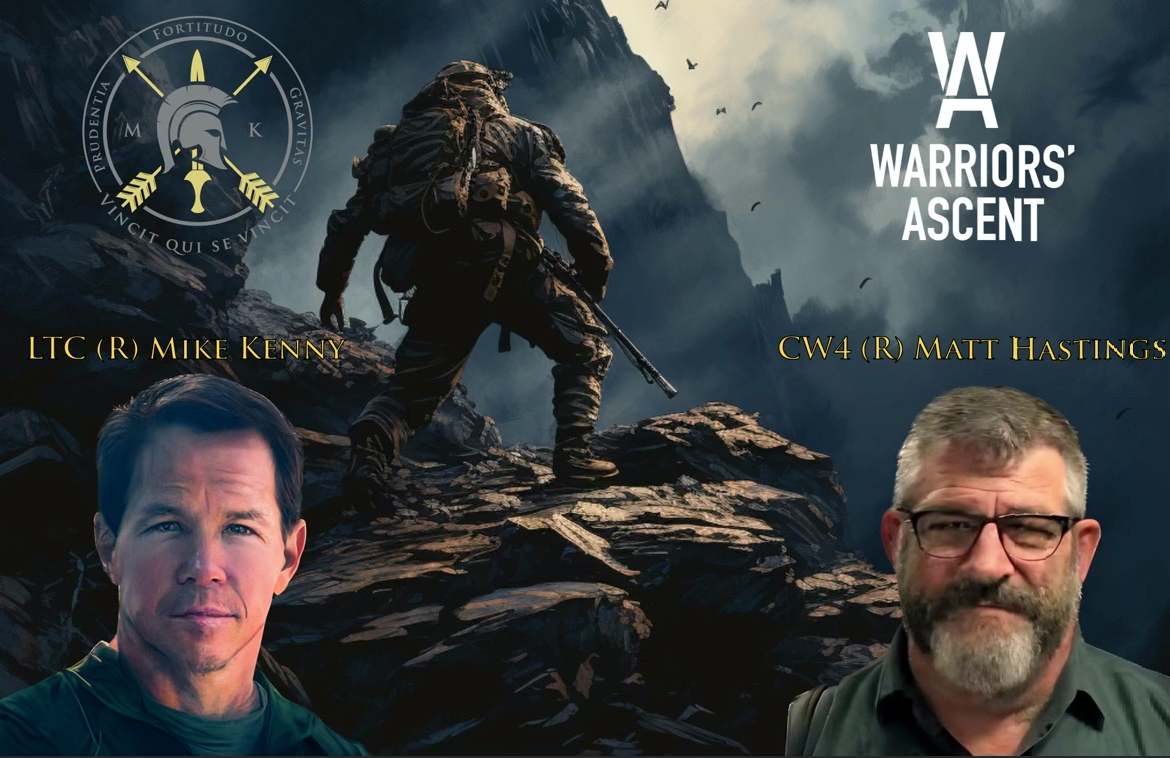
Join Mike Kenny and Matt Hastings, two retired US Army officers who served in US Army Special Forces and Aviation Units, as they share with you the optimal performance practices they learned in their time with the military and Warriors’ Ascent, a 501(c)(3) nonprofit organization that helps Veterans and First Responders dealing with post-traumatic stress. Best practices developed to fortify the mind, body, and soul to strengthen your resolve and conquer life’s challenges.
Vincit Qui Se Vincit
Listen on:







Episodes
Friday Dec 22, 2023
Friday Dec 22, 2023
S2:E6 Self-Efficacy: Agency-Belief in Capacity to Act and Achieve Goals
Robin Sage, G's, test mission/confidence target to assess capabilities and build confidence.
-An assessment of technical and tactical proficiency but also a psychological component as well.
-To have a belief in your effectiveness you must BE effective and chalk up wins even small ones (mastery experiences)
-Growth mindset
-Stretch goals: deliberate discomfort, mastery/growth experiences
-Seeing others similar to you succeed.
-Agency
-Motivation 2.0: Autonomy, MASTERY, purpose
In psychology, self-efficacy is an individual's belief in their capacity to act in the ways necessary to reach specific goals.[1] The concept was originally proposed by the psychologist Albert Bandura.
Self-efficacy affects every area of human endeavor. By determining the beliefs a person holds regarding their power to affect situations, self-efficacy strongly influences both the power a person actually has to face challenges competently and the choices a person is most likely to make.
A strong sense of self-efficacy promotes human accomplishment and personal well-being. A person with high self-efficacy views challenges as things that are supposed to be mastered rather than threats to avoid. These people are able to recover from failure faster and are more likely to attribute failure to a lack of effort. They approach threatening situations with the belief that they can control them. These things have been linked to lower levels of stress and a lower vulnerability to depression.
In contrast, people with a low sense of self-efficacy view difficult tasks as personal threats and shy away from them. Difficult tasks lead them to look at the skills they lack rather than the ones they have. It is easy for them to lose faith in their own abilities after a failure. Low self-efficacy can be linked to higher levels of stress and depression.
Factors affecting self-efficacy
Bandura identifies four factors affecting self-efficacy.
Experience, or "enactive attainment" – The experience of mastery is the most important factor determining a person's self-efficacy. Success raises self-efficacy, while failure lowers it. According to psychologist Erik Erikson: "Children cannot be fooled by empty praise and condescending encouragement. They may have to accept artificial bolstering of their self-esteem in lieu of something better, but what I call their accruing ego identity gains real strength only from wholehearted and consistent recognition of real accomplishment, that is, achievement that has meaning in their culture."
Modeling, or "vicarious experience" – Modeling is experienced as, "If they can do it, I can do it as well". When we see someone succeeding, our own self-efficacy increases; where we see people failing, our self-efficacy decreases. This process is most effectual when we see ourselves as similar to the model. Although not as influential as direct experience, modeling is particularly useful for people who are particularly unsure of themselves.
Social persuasion – Social persuasion generally manifests as direct encouragement or discouragement from another person. Discouragement is generally more effective at decreasing a person's self-efficacy than encouragement is at increasing it.
Physiological factors – In stressful situations, people commonly exhibit signs of distress: shakes, aches and pains, fatigue, fear, nausea, etc. Perceptions of these responses in oneself can markedly alter self-efficacy.
Relationship to locus of control
Bandura showed that difference in self-efficacy correlates to fundamentally different world views. People with high self-efficacy generally believe that they are in control of their own lives, that their own actions and decisions shape their lives, while people with low self-efficacy may see their lives as outside their control. For example, a student with high self-efficacy who does poorly on an exam will likely attribute the failure to the fact that they did not study enough. However, a student with low self-efficacy who does poorly on an exam is likely to believe the cause of that failure was due to the test being too difficult or challenging, which the student does not control.
A negative effect of low self-efficacy is that it can lead to a state of learned helplessness. Learned helplessness was studied by Martin Seligman in an experiment in which shocks were applied to animals. Through the experiment, it was discovered that the animals placed in a cage where they could escape shocks by moving to a different part of the cage did not attempt to move if they had formerly been placed in a cage in which escape from the shocks was not possible. Low self-efficacy can lead to this state in which it is believed that no amount of effort will make a difference in the success of the task at hand.
Sources of self-efficacy
Mastery experiences
According to Bandura, the most effective way to build self-efficacy is to engage in mastery experiences.These mastery experiences can be defined as a personal experience of success. Achieving difficult goals in the face of adversity helps build confidence and strengthen perseverance.
Vicarious experiences of social models
Another source of self-efficacy is through vicarious experiences of social models. Seeing someone, who you view as similar to yourself, succeed at something difficult can motivate you to believe that you have the skills necessary to achieve a similar goal. However, the inverse of the previous statement is true as well. Seeing someone fail at a task can lead to doubt in personal skills and abilities. "The greater the assumed similarity, the more persuasive are the models' successes and failures."
Belief in success
A third source of self-efficacy is found through strengthening the belief that one has the ability to succeed. Those who are positively persuaded that they have the ability to complete a given task show a greater and more sustained effort to complete a task. It also lowers the effect of self-doubt in a person. However, it is important to remember that those who are doing the encouraging, put the person in a situation where success is more often likely to be attained. If they are put in a situation prematurely with no hope of any success, it can undermine self-efficacy.
Physiological and psychological states
A person's emotional and physiological state can also influence an individual's belief about their ability to perform in a given situation. When judging their own capabilities, people will often take in information from their body, how a person interprets that information impacts self-efficacy. For example, in activities that require physical strength, someone may take fatigue or pain as an indicator of inability.
-"I'm excited" vs "I'm nervous"
-The power of incremental wins
-"That's like me", "Needs work".
-Test missions
Friday Dec 15, 2023
Friday Dec 15, 2023
S2:E5 Critical Thinking: Quality and Clarity of Thought
The Miniature Guide to Critical Thinking: Concepts and Tools by Dr. Richard Paul and Dr. Linda Elder
Elements of Thought: Military Decision Making Process (MDMP)
Universal Intellectual Standards: CGSC
People talk about critical thinking, logic, and reasoning but what constitutes all of the above? How do you conceptualize critical thinking to discipline your thoughts and reasoning skills? Wouldn't it be nice if we could reduce critical thinking into its constituent parts and also apply some standards by which the quality of your thought could be measured? Well you're in luck! That is what we will discuss in this episode.
Elements of Thought: MDMP
-Purpose: Goals and objectives
Question at issue/at hand: problem, issue
-Information: data, facts, reasons, observations, experiences, evidence
-Interpretation and Inference: conclusions, solutions
-Concepts: theories, definitions, laws, principles, models
-Assumptions: presuppositions, axioms, taking for granted (valid, necessary)
-Implications and Consequences
-Point of View: frames of reference, perspectives, orientations (beliefs, experiences, antecedents)
Universal Intellectual Standards: making arguments and assertions properly
-Clarity: prerequisite for assessing other standards. "What can be done about education in the US" lacks clarity
-Accuracy: trueness, can be validated/confirmed
-Precision: specificity, detail, granularity
-Relevance: connection to the question, bearing on the problem or issue
-Depth: not superficial, not addressing the complexities of an issue adequately
-Breadth: comprehensive, taking into account other perspectives or arguments
-Logic: thoughts and assertions that are mutually supporting, they follow from one another
-Fairness: Have we considered relevant viewpoint in good faith? Ensuring we are not misrepresenting a position or distorting information to fit our needs ie deliberate use of logical fallacies.
Friday Dec 15, 2023
Friday Dec 15, 2023
People talk about critical thinking, logic, and reasoning but what constitutes all of the above? How do you conceptualize critical thinking to discipline your thoughts and reasoning skills? Wouldn't it be nice if we could reduce critical thinking into its constituent parts and also apply some standards by which the quality of your thought could be measured? Well you're in luck! That is what we will discuss in this episode.
Elements of Thought: MDMP
-Purpose: Goals and objectives
-Question at issue/at hand: problem, issue
-Information: data, facts, reasons, observations, experiences, evidence
-Interpretation and Inference: conclusions, solutions
-Concepts: theories, definitions, laws, principles, models
-Assumptions: presuppositions, axioms, taking for granted (valid, necessary)
-Implications and Consequences
-Point of View: frames of reference, perspectives, orientations (beliefs, experiences, antecedents)
Universal Intellectual Standards: making arguments and assertions properly
-Clarity: prerequisite for assessing other standards. "What can be done about education in the US" lacks clarity
-Accuracy: trueness, can be validated/confirmed
-Precision: specificity, detail, granularity
-Relevance: connection to the question, bearing on the problem or issue
-Depth: not superficial, not addressing the complexities of an issue adequately
-Breadth: comprehensive, taking into account other perspectives or arguments
-Logic: thoughts and assertions that are mutually supporting, they follow from one another
-Fairness: Have we considered relevant viewpoint in good faith? Ensuring we are not misrepresenting a position or distorting information to fit our needs ie deliberate use of logical fallacies.
Friday Dec 08, 2023
Friday Dec 08, 2023
We all like to think that we are creatures of logic, making rational decisions at every turn. The truth is that we are governed more by emotion than we'd like to believe. Have you ever just "gone with your gut" or just felt something was amiss? Sometimes this is System 1 kicking in at a subconscious level deferring to past experience and recognized patterns. Sometimes it's correct and serves you well by averting disaster but sometimes it leads you astray. When this is the case we must engage our System 2 critical thinking skills. Critical thinking is an essential skill, one that is becoming less prevalent in our society. In many regards, emotionalism has replaced rationalism. This pertains to both internal and external dialogue and argumentation which can lead to a variety of issues both at an individual and societal level. But what are the obstacles to critical thinking and logical decision-making? Why isn't it as easy and straightforward as it seems? We'll discuss the impediments to critical thinking and reasoning in this episode in an effort to discipline your thought processes.
Cognitive Distortions: From CBT
A cognitive distortion is an exaggerated or irrational thought pattern involved in the onset or perpetuation of psychopathological states, such as depression and anxiety. Cognitive distortions are thoughts that cause individuals to perceive reality inaccurately. According to Aaron Beck's cognitive model, a negative outlook on reality, sometimes called negative schemas (or schemata), is a factor in symptoms of emotional dysfunction and poorer subjective well-being. Specifically, negative thinking patterns reinforce negative emotions and thoughts.
Cognitive Distortion
Example
All-or-none thinking
“I never do things right”
Overgeneralizing
“I overslept today because I’m such an irresponsible person”
Minimizing positives
“A month of sobriety is no big deal”
Maximizing negatives
“I missed a payment on my car, so I’ll never have good credit”
Shoulds and musts
“I should never be late for anything”
Labeling
“I am such a loser”
Emotional reasoning
“I felt guilty putting my child in time-out, so I must have done it wrong”
Fortune telling
“If I go to that event, I’ll probably be anxious the whole time”
Selective abstractions
“It’s my fault that people at the party didn’t have fun”
Finally, many of us engage in emotional reasoning, a process in which our negative feelings about ourselves inform our thoughts, as if they were factually based, in the absence of any facts to support these unpleasant feelings. In other words, your emotions and feelings about a situation become your actual view of the situation, regardless of any information to the contrary. (mention Coddling of the American Mind by Jonathan Haidt)
-Daily Thought Record as a means to correct
Logical Fallacies:
A logical fallacy is a flaw in reasoning that makes an argument invalid, unsound, or misleading. It's important to identify and understand logical fallacies because they can weaken the strength of an argument and lead to erroneous conclusions. Here is a list of some common logical fallacies along with explanations for each:
**Ad Hominem**
*Description*: This fallacy attacks the person making the argument rather than addressing the argument itself. It focuses on personal characteristics, irrelevant to the issue at hand.
*Example*: "You can't trust John's opinion on politics; he's never even been to college."
**Straw Man**
*Description*: This fallacy involves misrepresenting or distorting an opponent's argument to make it easier to attack. It's like setting up a weaker version of the argument to knock down.
*Example*: "People who oppose stricter gun control laws just want a society with no rules and everyone carrying guns all the time."
**Appeal to Authority**
*Description*: This fallacy relies on the testimony of an authority figure, rather than providing solid evidence or reasoning.
*Example*: "Dr. Smith says that climate change is a hoax, so it must be true."
**Circular Reasoning (Begging the Question)**
*Description*: This occurs when the conclusion of an argument is assumed in the premise, essentially restating the same idea in different words.
*Example*: "God exists because the Bible says so, and we know the Bible is true because it's the word of God."
**False Dilemma (False Dichotomy)**
*Description*: This fallacy presents only two options when there are actually more available. It oversimplifies a complex situation.
*Example*: "You're either with us or against us."
**Hasty Generalization**
*Description*: This involves making a sweeping generalization based on insufficient evidence. It draws a conclusion about a whole group based on a small sample size.
*Example*: "I met one rude person from that country, so everyone from there must be rude."
**Appeal to Ignorance**
*Description*: This fallacy claims that a statement must be true because it hasn't been proven false, or vice versa.
*Example*: "No one has proven that ghosts don't exist, so they must be real."
**Post Hoc (False Cause)**
*Description*: This fallacy asserts that because one event occurred after another, the first event must have caused the second. It assumes causation without adequate evidence.
*Example*: "I wore my lucky socks and we won the game, so my socks must be lucky."
**Slippery Slope**
*Description*: This fallacy suggests that a particular event will set off a chain reaction, leading to a much larger, usually negative, outcome.
*Example*: "If we allow same-sex marriage, next people will want to marry animals."
**Red Herring**
*Description*: This involves diverting attention away from the main issue by introducing an unrelated topic or argument.
*Example*: "We should focus on solving unemployment, not on healthcare reform."
**Appeal to Emotion**
*Description*: This fallacy attempts to manipulate emotions (fear, pity, love, etc.) in order to win an argument, often without providing any substantial evidence.
*Example*: "If we don't pass this law, think of all the children who will suffer!"
**Genetic Fallacy**
*Description*: This fallacy involves judging the merit of an idea or claim based on its origin or source.
*Example*: "You shouldn't read that book, it was written by a criminal."
Recognizing logical fallacies is an important skill in critical thinking and argumentation. It helps ensure that arguments are based on sound reasoning and evidence rather than misleading tactics.
Friday Dec 08, 2023
Friday Dec 08, 2023
We all like to think that we are creatures of logic, making rational decisions at every turn. The truth is that we are governed more by emotion than we'd like to believe. Have you ever just "gone with your gut" or just felt something was amiss? Sometimes this is System 1 kicking in at a subconscious level deferring to past experience and recognized patterns. Sometimes it's correct and serves you well by averting disaster but sometimes it leads you astray. When this is the case we must engage our System 2 critical thinking skills. Critical thinking is an essential skill, one that is becoming less prevalent in our society. In many regards, emotionalism has replaced rationalism. This pertains to both internal and external dialogue and argumentation which can lead to a variety of issues both at an individual and societal level. But what are the obstacles to critical thinking and logical decision-making? Why isn't it as easy and straightforward as it seems? We'll discuss the impediments to critical thinking and reasoning in this episode in an effort to discipline your thought processes.
Cognitive Distortions: From CBT
A cognitive distortion is an exaggerated or irrational thought pattern involved in the onset or perpetuation of psychopathological states, such as depression and anxiety. Cognitive distortions are thoughts that cause individuals to perceive reality inaccurately. According to Aaron Beck's cognitive model, a negative outlook on reality, sometimes called negative schemas (or schemata), is a factor in symptoms of emotional dysfunction and poorer subjective well-being. Specifically, negative thinking patterns reinforce negative emotions and thoughts.
Cognitive Distortion
Example
All-or-none thinking
“I never do things right”
Overgeneralizing
“I overslept today because I’m such an irresponsible person”
Minimizing positives
“A month of sobriety is no big deal”
Maximizing negatives
“I missed a payment on my car, so I’ll never have good credit”
Shoulds and musts
“I should never be late for anything”
Labeling
“I am such a loser”
Emotional reasoning
“I felt guilty putting my child in time-out, so I must have done it wrong”
Fortune telling
“If I go to that event, I’ll probably be anxious the whole time”
Selective abstractions
“It’s my fault that people at the party didn’t have fun”
Finally, many of us engage in emotional reasoning, a process in which our negative feelings about ourselves inform our thoughts, as if they were factually based, in the absence of any facts to support these unpleasant feelings. In other words, your emotions and feelings about a situation become your actual view of the situation, regardless of any information to the contrary. (mention Coddling of the American Mind by Jonathan Haidt)
-Daily Thought Record as a means to correct
Logical Fallacies:
A logical fallacy is a flaw in reasoning that makes an argument invalid, unsound, or misleading. It's important to identify and understand logical fallacies because they can weaken the strength of an argument and lead to erroneous conclusions. Here is a list of some common logical fallacies along with explanations for each:
**Ad Hominem**
*Description*: This fallacy attacks the person making the argument rather than addressing the argument itself. It focuses on personal characteristics, irrelevant to the issue at hand.
*Example*: "You can't trust John's opinion on politics; he's never even been to college."
**Straw Man**
*Description*: This fallacy involves misrepresenting or distorting an opponent's argument to make it easier to attack. It's like setting up a weaker version of the argument to knock down.
*Example*: "People who oppose stricter gun control laws just want a society with no rules and everyone carrying guns all the time."
**Appeal to Authority**
*Description*: This fallacy relies on the testimony of an authority figure, rather than providing solid evidence or reasoning.
*Example*: "Dr. Smith says that climate change is a hoax, so it must be true."
**Circular Reasoning (Begging the Question)**
*Description*: This occurs when the conclusion of an argument is assumed in the premise, essentially restating the same idea in different words.
*Example*: "God exists because the Bible says so, and we know the Bible is true because it's the word of God."
**False Dilemma (False Dichotomy)**
*Description*: This fallacy presents only two options when there are actually more available. It oversimplifies a complex situation.
*Example*: "You're either with us or against us."
**Hasty Generalization**
*Description*: This involves making a sweeping generalization based on insufficient evidence. It draws a conclusion about a whole group based on a small sample size.
*Example*: "I met one rude person from that country, so everyone from there must be rude."
**Appeal to Ignorance**
*Description*: This fallacy claims that a statement must be true because it hasn't been proven false, or vice versa.
*Example*: "No one has proven that ghosts don't exist, so they must be real."
**Post Hoc (False Cause)**
*Description*: This fallacy asserts that because one event occurred after another, the first event must have caused the second. It assumes causation without adequate evidence.
*Example*: "I wore my lucky socks and we won the game, so my socks must be lucky."
**Slippery Slope**
*Description*: This fallacy suggests that a particular event will set off a chain reaction, leading to a much larger, usually negative, outcome.
*Example*: "If we allow same-sex marriage, next people will want to marry animals."
**Red Herring**
*Description*: This involves diverting attention away from the main issue by introducing an unrelated topic or argument.
*Example*: "We should focus on solving unemployment, not on healthcare reform."
**Appeal to Emotion**
*Description*: This fallacy attempts to manipulate emotions (fear, pity, love, etc.) in order to win an argument, often without providing any substantial evidence.
*Example*: "If we don't pass this law, think of all the children who will suffer!"
**Genetic Fallacy**
*Description*: This fallacy involves judging the merit of an idea or claim based on its origin or source.
*Example*: "You shouldn't read that book, it was written by a criminal."
Recognizing logical fallacies is an important skill in critical thinking and argumentation. It helps ensure that arguments are based on sound reasoning and evidence rather than misleading tactics.
Key takeaways:
Cognitive distortions: exaggerated or irrational thought pattern
Logical fallacies: Flaws in reasoning that make an argument invalid
Friday Dec 01, 2023
Friday Dec 01, 2023
Have you ever wanted to push yourself, try something new, set a stretch-goal, or take on a compelling challenge or opportunity only to stop short and play it safe for fear of failure or looking like a fool?
-Once committed to taking action and embarking on such an endeavor, have you ever lost focus on the objective or gotten sidelined once the impediments to your action began to present themselves?
ie The going got tough but you didn't keep going?
This episode will discuss a few mental frameworks and mindsets to keep you mission-focused.
Quotes:
"You will either step forward into growth or back into safety" -Abraham Maslow
"The successful warrior is the average man with laser-like focus"- Bruce Lee
Growth vs Fixed Mindset: Carol Dweck
There are two theories of intelligence, referred to simply as mindsets, that students can have about their intellectual abilities, although no one has purely one or the other, she said. Individuals with more of a fixed mindset believe that their intellectual abilities are simply fixed. They tend to approach learning with the goal of looking smart, and they often shy away from challenges because they believe that having to work hard at something or making mistakes means they don’t have high ability. Those with more of a growth mindset, on the other hand, believe that abilities can be developed—they are more likely to see effort as something that propels learning and to see setbacks as opportunities to build new skills.
“A growth mind-set leads to an increased likelihood of learning from mistakes,” Moser and colleagues wrote in Psychological Science.
WIN: Lou Holtz, Notre Dame football coach
WHY DOES W.I.N. WORK?
“What’s Important Now?” forces your mind to consider your priorities and TAKE Action on them. Once you decide something is important, each time you ask yourself the W.I.N. question, you are reminded that NOW is the time to take action and move in the direction of your goal!
Reticular Activating System (RAS): The other reason it works is the fact that “What we focus on increases”. If we focus on the negative things happening in our lives, we see more negatives. By focusing on the positives, we see that there are more good things going on than we may have thought. When you focus on your priorities and goals, you begin to see opportunities and new ways to achieve them. So why don’t we focus on the positives?
WOOP: Gabriele Oettingen "Rethinking Positive Thinking"
“I reasoned that the best way to get people up and moving was to ask them to dream and then to confront them right away with the realities that stood in the way of their dreams…If I could ground fantasies in a reality through mental contrasting, I might be able to circumvent the calming effects of dreaming and mobilize dreams as a tool for prompting directed action.”
~ Gabrielle Oettingen, Rethinking Positive Thinking
-Wish: goal, objective, desire
-Outcome: benefit derived, (affective, emotional, visceral); Get emotionally invested
-Obstacle: What stands in your way? Internal (limiting beliefs/mindsets) and external obstacles
-Plans: Contingencies, what ifs?, If/then implementation intentions
*Note: pre-commitments (discipline) stronger than motivation
Mindfulness
-Intention: Knowing why we are here; Our personal vision, goal, aspiration; Intention as the guidestar
-Attention: Present moment awareness; only thing you can control are your own reasoned thoughts-Marcus
-Attitude: Nonjudgemental observation-"What and how we practice becomes stronger": acceptance, kindness, openness, curiosity
Key takeaways:
Growth vs Fixed Mindset
WIN: What's important now
WOOP: (mental contrasting) Wish, Outcome, Obstacle, Plans
Mindfulness: Intention, Attention, Attitude
Friday Dec 01, 2023
Friday Dec 01, 2023
-Have you ever wanted to push yourself, try something new, set a stretch-goal, or take on a compelling challenge or opportunity only to stop short and play it safe for fear of failure or looking like a fool?
-Once committed to taking action and embarking on such an endeavor, have you ever lost focus on the objective or gotten sidelined once the impediments to your action began to present themselves?
ie The going got tough but you didn't keep going?
This episode will discuss a few mental frameworks and mindsets to keep you mission-focused.
Quotes:
"You will either step forward into growth or back into safety" -Abraham Maslow
"The successful warrior is the average man with laser-like focus"- Bruce Lee
Growth vs Fixed Mindset: Carol Dweck
There are two theories of intelligence, referred to simply as mindsets, that students can have about their intellectual abilities, although no one has purely one or the other, she said. Individuals with more of a fixed mindset believe that their intellectual abilities are simply fixed. They tend to approach learning with the goal of looking smart, and they often shy away from challenges because they believe that having to work hard at something or making mistakes means they don’t have high ability. Those with more of a growth mindset, on the other hand, believe that abilities can be developed—they are more likely to see effort as something that propels learning and to see setbacks as opportunities to build new skills.
“A growth mind-set leads to an increased likelihood of learning from mistakes,” Moser and colleagues wrote in Psychological Science.
WIN: Lou Holtz, Notre Dame football coach
WHY DOES W.I.N. WORK?
“What’s Important Now?” forces your mind to consider your priorities and TAKE Action on them. Once you decide something is important, each time you ask yourself the W.I.N. question, you are reminded that NOW is the time to take action and move in the direction of your goal!
Reticular Activating System (RAS): The other reason it works is the fact that “What we focus on increases”. If we focus on the negative things happening in our lives, we see more negatives. By focusing on the positives, we see that there are more good things going on than we may have thought. When you focus on your priorities and goals, you begin to see opportunities and new ways to achieve them. So why don’t we focus on the positives?
WOOP: Gabriele Oettingen "Rethinking Positive Thinking"
“I reasoned that the best way to get people up and moving was to ask them to dream and then to confront them right away with the realities that stood in the way of their dreams…If I could ground fantasies in a reality through mental contrasting, I might be able to circumvent the calming effects of dreaming and mobilize dreams as a tool for prompting directed action.”
~ Gabrielle Oettingen, Rethinking Positive Thinking
-Wish: goal, objective, desire
-Outcome: benefit derived, (affective, emotional, visceral); Get emotionally invested
-Obstacle: What stands in your way? Internal (limiting beliefs/mindsets) and external obstacles
-Plans: Contingencies, what ifs?, If/then implementation intentions
*Note: pre-commitments (discipline) stronger than motivation
Mindfulness
-Intention: Knowing why we are here; Our personal vision, goal, aspiration; Intention as the guidestar
-Attention: Present moment awareness; only thing you can control are your own reasoned thoughts-Marcus
-Attitude: Nonjudgemental observation-"What and how we practice becomes stronger": acceptance, kindness, openness, curiosity
Key takeaways:
Growth vs Fixed Mindset
WIN: What's important now
WOOP: (mental contrasting) Wish, Outcome, Obstacle, Plans
Mindfulness: Intention, Attention, Attitude
Friday Nov 24, 2023
Friday Nov 24, 2023
Have you ever felt like you were going through the motions? Like some mindless unenthusiastic drone or automaton just showing up and executing. "Time to make the donuts". Are you interested in learning some ways to tap into that motivation and enthusiasm and the mindset shifts required to push through and get things done? Todays episode focuses on motivation and how to spur yourself into action.
Friday Nov 24, 2023
Friday Nov 24, 2023
Warrior Operating System
Have you ever felt like you were going through the motions? Like some mindless unenthusiastic drone or automaton just showing up and executing. "Time to make the donuts". Are you interested in learning some ways to tap into that motivation and enthusiasm and the mindset shifts required to push through and get things done? Todays episode focuses on motivation and how to spur yourself into action.
Friday Nov 17, 2023
Friday Nov 17, 2023
We've all had days where something was amiss. It was hard to put your finger on it but something wasn't quite right. Maybe not outright despondence or despair but not feeling like yourself. Languishing, flat, apathetic, etc. Whether your focus is healing (ie getting back on track) or high-performance (executing a the high level) it's important to have a system that gets you there. Part diagnostic tool, part prescription, the Warrior Operating System is the rubric we will use to both identify the root cause and potential remedy for the issues you're contending with.
Discussion:
Slide 1.
Why have a system? Process vs outcome. With Winning In Mind.
Healing vs High-Performance
Basics vs Advanced
WOS 1.0 vs WOS 2.0
Linear/hierarchical vs Cyclical: What's most important? What comes first?
Slide 2.
For our purposes we present this model: Mind, Body, Soul---> Prudential, Fortitudo, Gravitas
Slide 3.
The entire system. We will break it out piece by piece in future episodes. Our intent today is to present the Warrior operating System as a rubric
The Warrior's Ascent Podcast
What you can expect from this podcast: Accompany Mike and Matt, two retired US Army officers, on their lifelong Hero's Journey where they share the trials, tribulations, successes, failures, and valuable lessoned learned they've garnered throughout their Army careers and at Warriors' Ascent, a 501(c)(3) nonprofit organization that helps veterans and first responders with post-traumatic stress get on the path to healing in order to live joyous, fulfilling, and purposeful lives. Our goal is to provide actionable information through compelling stories, anecdotes, and cutting edge research that will empower the listener to take ownership of their life and thrive.